News
- 2025-12-04
- 851
- 5 Comments
Process Innovation in Precision Mold Parts Processing: Redefining Efficiency and Quality
In the fast-paced world of manufacturing, innovation is the key to staying competitive. At our precision mold parts processing facility, we are committed to adopting the latest technologies and techniques to redefine what’s possible in mold component manufacturing. From 3D printing for rapid prototyping to AI-powered process optimization, our innovative approaches deliver faster lead times, higher quality, and lower costs—helping our clients meet the evolving demands of their industries.
3D Printing: Accelerating Prototyping and Low-Volume Production
3D printing (additive manufacturing) has revolutionized precision mold parts processing, particularly for prototyping and low-volume production. Unlike traditional subtractive machining, which removes material to create a part, 3D printing builds parts layer by layer from a digital model. This allows us to produce complex mold components—such as conformal cooling channels or intricate cavities—in a fraction of the time required by traditional methods. For example, a prototype mold cavity that would take 2-3 weeks to machine can be 3D printed in 2-3 days, enabling clients to test and iterate designs faster. Additionally, 3D printing reduces material waste (by using only the material needed for the part) and enables design freedom, allowing for geometries that are impossible to achieve with subtractive machining. We use high-precision 3D printers (e.g., SLM, SLA) with layer resolutions as fine as 10μm, ensuring that prototype parts match the accuracy of production-grade components.
AI-Powered Process Optimization: Minimizing Errors and Maximizing Efficiency
Artificial intelligence (AI) is transforming precision mold parts processing by enabling real-time process optimization. Our machining centers are equipped with AI-driven software that monitors key parameters—such as cutting speed, feed rate, and tool temperature—during production. The AI algorithm analyzes this data to identify potential issues (e.g., tool wear, material deformation) before they cause defects, adjusting process parameters automatically to maintain quality. For example, if the AI detects that a cutting tool is wearing down, it will slow the feed rate slightly to prevent surface finish defects. This not only reduces scrap rates but also extends tool life and improves production efficiency. Additionally, AI-powered predictive maintenance alerts us to potential machine failures before they occur, minimizing downtime and ensuring on-time delivery.
Hybrid Machining: Combining the Best of Subtractive and Additive Technologies
Hybrid machining—combining subtractive processes (e.g., CNC milling) with additive processes (e.g., 3D printing)—is another innovative approach we use to optimize precision mold parts processing. For example, we may 3D print a mold core with conformal cooling channels (additive) and then use CNC milling to achieve the final surface finish and dimensional accuracy (subtractive). This hybrid approach leverages the design freedom of 3D printing and the precision of CNC machining, delivering components that are both functional and accurate. Hybrid machining is particularly useful for complex mold parts that require both intricate internal features (e.g., cooling channels) and tight external tolerances. By combining these technologies, we reduce production time by up to 40% compared to traditional methods, while maintaining the ultra-precision our clients expect.
Key SEO Keywords: precision mold parts process innovation, 3D printed mold components, AI-powered mold machining, hybrid mold processing, innovative mold manufacturing techniques
Related Posts
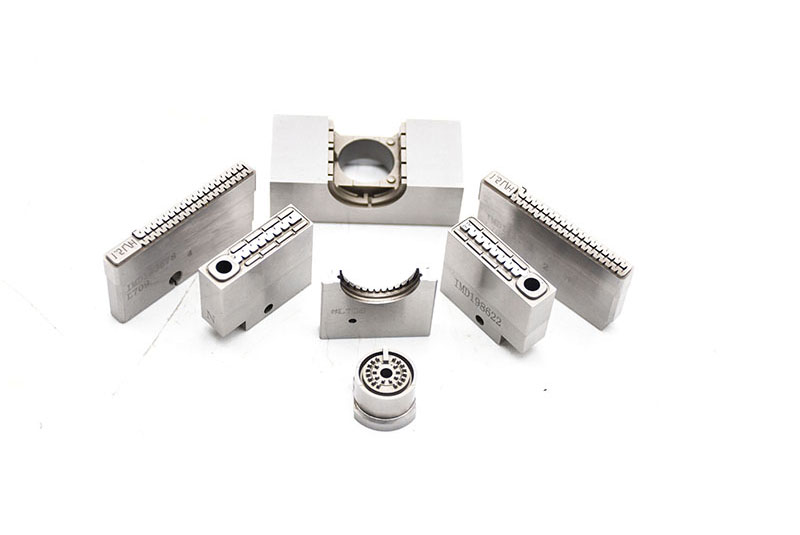
- Precision Irrigation mold cavity and spare parts
- zefu-mold
- 1442
Precision Multi-cavity Injection Mold for Irrigation Part
Explore More